
Fiber Internet Connectivity in San Antonio
SATC Multi-Carrier Enterprise Network
Introduction
Most commercial office buildings in San Antonio offer business internet the same way: a single ISP, a handoff at the demarc, and a support number when it stops working.
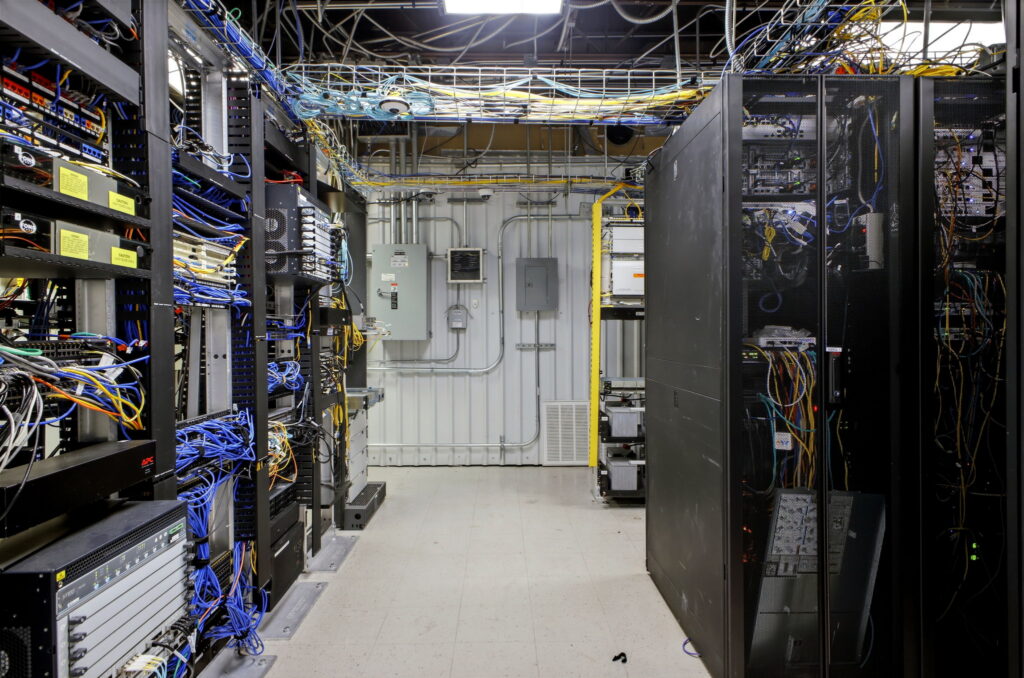
SATC runs a different architecture. San Antonio Technology Center maintains direct transit peering relationships with three independent carriers — AT&T, Spectrum, and Level 3 (Lumen) — providing multi-carrier fiber to the building’s office tenants and colocation clients. The result is not just faster internet. It is internet infrastructure that does not have a single point of failure, does not depend on the health of any one provider’s network, and does not require your team to stop working when a carrier has a disruption.
For technology companies, life sciences operations, cybersecurity firms, and any business running workloads where connectivity is not optional — this is what the infrastructure looks like at 3463 Magic Dr.
Three-Carrier Peering: What It Means and Why It Matters
Transit peering is the relationship between a network and the major internet backbone carriers that carry global traffic. SATC maintains direct peering with:
- AT&T — one of the two major fiber network operators in the San Antonio market, with extensive local loop infrastructure in the Medical Center district
- Spectrum Business — the second major commercial fiber carrier serving San Antonio, providing an independent path with full backbone connectivity
- Level 3 / Lumen Technologies — a Tier 1 global internet carrier with North American backbone capacity that provides international routing and carrier-grade performance for latency-sensitive traffic.
Having all three at a single building means:
Redundancy without manual intervention.
Performance optimization in real time
Carrier optionality for tenants with specific requirements
Symmetric Speeds for Data-Intensive Workloads
The bandwidth requirements of the businesses that operate at SATC are not typical commercial office internet loads.
Genomic sequencing datasets run hundreds of gigabytes to multiple terabytes per experiment. Cybersecurity event log aggregation across enterprise environments generates sustained multi-hundred-megabit flows. SaaS platforms serving clients in real time require guaranteed uplink performance, not just downlink capacity. Video production and broadcast workflows demand consistent upload throughput.
SATC’s fiber infrastructure provides symmetric speeds — equivalent upload and download capability — rather than the asymmetric connections (fast download, slow upload) that characterize residential and most standard commercial ISP products.
Why symmetry matters:
- Remote backup and off-site replication performance is determined by upload speed — symmetric connections eliminate this bottleneck
- Cloud application architectures increasingly assume bidirectional data flows; symmetric connections align with how modern workloads actually use bandwidth
- Video conferencing and unified communications performance is upload-dependent — your team’s outbound video quality is a function of uplink capacity
Low Latency for Real-Time Applications
Bandwidth is one dimension of connectivity performance. Latency — the round-trip time between a request and a response — is the other, and for real-time applications, it is often more important than raw speed.
SATC’s network architecture is optimized for low-latency operation:
- Direct carrier peering eliminates the transit hops that accumulate when traffic passes through an ISP’s aggregation network before reaching a backbone
- The building’s network hardware is maintained and monitored by the same on-site team that operates the data center — issues are identified and resolved by people in the building, not routed through a remote NOC
- SATC Co-Location clients benefit from ultra-low latency between their hosted equipment and their office networks — the physical distance between the data center floor and the office suites is measured in meters, not miles
Applications where SATC’s latency architecture delivers measurable differences:
- VoIP and unified communications (Microsoft Teams, Zoom, RingCentral)
- Financial trading platforms and real-time data feeds
- Remote desktop and virtual desktop infrastructure (VDI)
- Real-time bioinformatics and laboratory instrument control systems
- Cybersecurity platforms requiring live threat intelligence feeds
Network Redundancy Beyond the Carrier Layer
Carrier diversity is one layer of SATC’s redundancy architecture. The physical and equipment layers below it are built to the same standard.
Physical pathway redundancy: SATC’s fiber infrastructure includes [PENDING: Evan Gray — confirm physical pathway redundancy: dual conduit entries, separate cable runs, meet-me room configuration] to ensure that a physical facility event — a construction dig-up, a conduit failure — does not take down all connectivity simultaneously.
Equipment redundancy: Network hardware throughout SATC’s infrastructure is configured with [PENDING: Evan Gray — confirm equipment redundancy level: N+1 or higher for core routing/switching hardware].
Power-backed network infrastructure: The same power generation systems that back the data center floor also support SATC’s network equipment. A utility power failure does not take the building’s network offline.
This infrastructure depth is what separates enterprise-grade connectivity from commercial ISP service — and it is what SATC delivers to tenants who need to stay online regardless of what is happening outside the building.
Provisioning Timeline: Online in Days
When your business needs internet connectivity established at a new San Antonio location, the timeline from agreement to operational connection matters.
SATC provisions tenant connectivity [PENDING: Evan Gray — confirm standard provisioning timeline for new tenant internet in days] from signed agreement. This is not a typical commercial ISP new-service installation timeline — it reflects an infrastructure environment that is already built and operating, not one that needs to be provisioned from outside the building on a carrier work order.
For businesses establishing a new San Antonio office, relocating to the Medical Center district, or staging a rapid market entry — SATC’s provisioning speed is a practical advantage.
Fiber Connectivity for SATC Co-Location Clients
SATC Co-Location clients benefit from the same carrier-diverse fiber infrastructure that serves the office environment — with additional configuration options appropriate for hosted infrastructure environments.
Colocation clients can [PENDING: Evan Gray/Travis — confirm colocation-specific fiber options: dedicated VLANs, cross-connect to specific carriers, Ethernet handoff specs, burstable bandwidth options].
The combination of physical proximity — office and data center in the same building — and shared carrier-diverse fiber infrastructure means SATC is the only address in San Antonio where a technology operation can have its team and its infrastructure on the same network, at the same address, backed by the same carrier architecture.