

Signing a commercial office lease in San Antonio is a 3–10 year commitment. For a technology company, a life sciences operation, or a cybersecurity firm, that commitment carries specific risks that a generic office tenant doesn’t face — because the infrastructure in the building matters as much as the square footage.
This guide covers the five evaluation criteria that technology companies consistently underweight when looking at San Antonio office space, and the questions worth asking before you commit.
1. Connectivity: Beyond “High-Speed Internet”
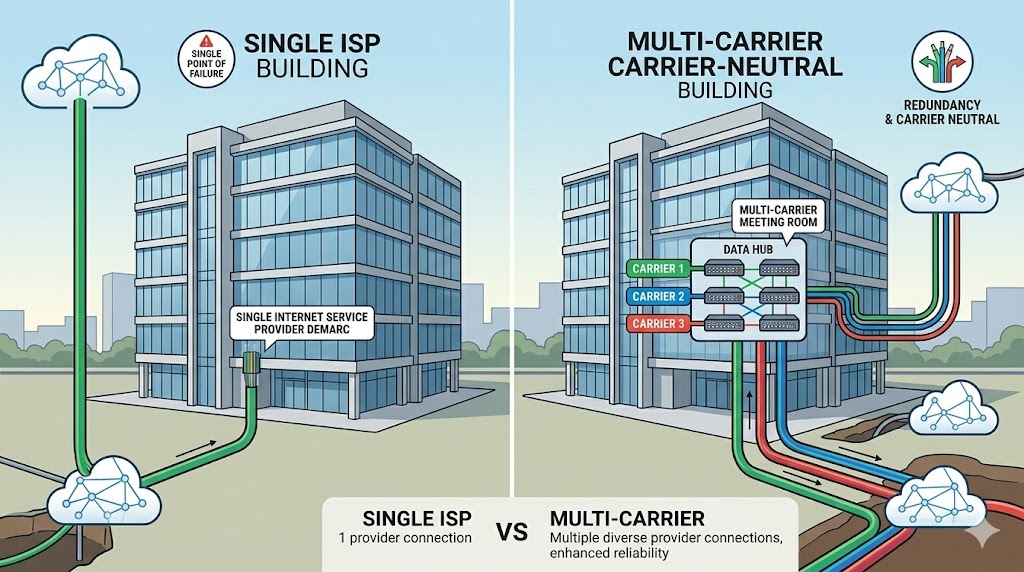
Every commercial office building in San Antonio advertises high-speed internet. Almost none of them will tell you which carrier provides it, what happens when that carrier has an outage, or whether the speeds are symmetric.
For technology companies, the gap between “has internet” and “has enterprise-grade internet” is significant.
What to ask:
- Which carrier(s) are in the building? Is it a single ISP or multiple independent providers?
- Are speeds symmetric — equal upload and download capacity — or asymmetric (fast download, slow upload)?
- What is the failover plan if the primary carrier has a disruption?
- What is the provisioning timeline for a new tenant to get connected?
Why it matters: Single-carrier buildings are a single point of failure. If your ISP has a regional outage or a fiber cut in the building, your team is offline until they fix it. For technology companies where connectivity is the product — SaaS platforms, real-time data environments, client-facing services — this is not a theoretical risk. It is a recurring operational event in San Antonio’s commercial building stock.
Multi-carrier buildings with automatic failover between providers maintain connectivity through single-carrier disruptions. The architecture is common in carrier hotels and internet exchange facilities, and uncommon in standard commercial office buildings.
What SATC provides: Direct transit peering with AT&T, Spectrum, and Level 3 — three independent fiber carriers with automatic routing across available providers.Full connectivity details →
2. Physical Security: What “Secure Building” Actually Means
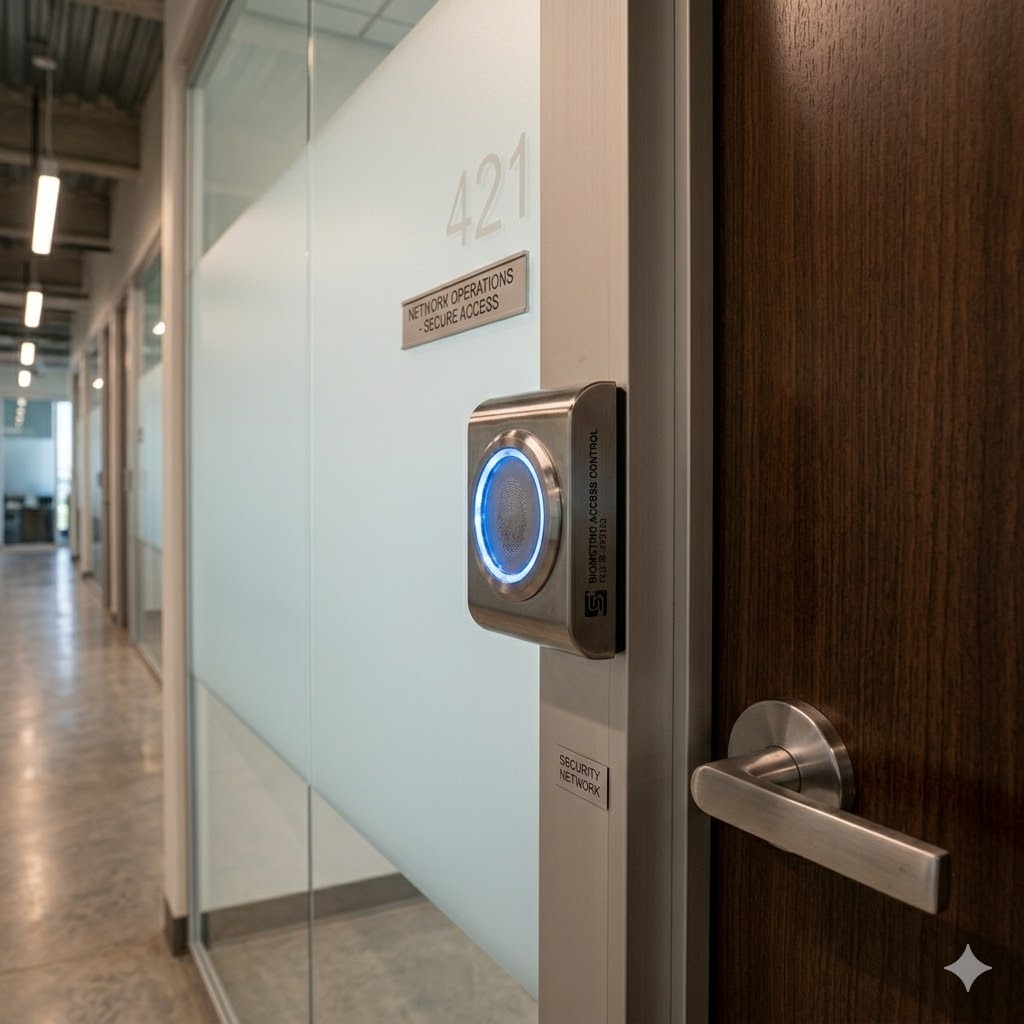
“Secure building” in a commercial real estate listing typically means a key card to get into the lobby and a security camera over the front door. For technology companies handling proprietary data, regulated information, or client-confidential systems, this level of security is a liability, not an asset.
What to ask:
- What authentication method is used for building access? Key card, key fob, or biometric?
- Is access logged — and for how long are logs retained?
- What is the camera coverage? Lobby only, or full building coverage including corridors and access points?
- Is there after-hours building access for tenants?
Why it matters: Healthcare-adjacent businesses, cybersecurity firms, defense contractors, and clinical research organizations operating under HIPAA, CMMC, SOC 2, or similar frameworks are required to maintain documented physical access controls. In a compliance audit, “the building had a key card system” is not sufficient evidence — you need logged access records, documented camera coverage, and documented access control procedures.
Biometric authentication (fingerprint) is meaningfully more secure than key cards or fobs because it cannot be shared, transferred, or lost. Logged access records create the audit trail that compliance frameworks require.
What SATC provides: Biometric fingerprint access at the building entry level, 24/7 HD camera coverage throughout the facility, and cage key system access for the data center environment. Every entry is logged.Full security specifications →
3. Data Infrastructure: Where Is Your Hardware Going?
Technology companies need to think about where their physical infrastructure lives — not just where their people sit. For companies running servers, storage, networking hardware, or backup systems, the options are: remote data center (separate address), cloud-only, or on-site (in the building where you work).
What to ask:
- Is there a server room or colocation facility in the building?
- If not, what is the closest carrier-grade colocation option, and what does a split-site management arrangement actually cost operationally?
- If there is on-site colocation, what are the power, cooling, and carrier options?
Why it matters: Split-site management — where your team works at one address and your infrastructure lives at another — creates operational overhead that compounds over time. When a physical server needs a reboot, a network configuration needs to change, or a hardware failure needs immediate physical attention, the question is whether your team can walk down the hall or needs to drive across town.
For organizations that can consolidate office and infrastructure at the same address, the operational simplification is meaningful. For organizations that genuinely need hyperscale infrastructure, a separate colocation facility makes sense. For the vast majority of San Antonio technology companies operating below that threshold, building proximity matters.
What SATC provides: SATC Co-Location operates inside the building, providing cabinet space with enterprise power, carrier-diverse fiber, and on-site NOC support. Your team and your hardware are at the same address.Data center details →
4. Location: The Ecosystem Question That Lease Listings Don’t Answer
Commercial real estate listings show price per square foot and building class. They do not show you who else is in the building, what institutions are nearby, or whether the address puts you in proximity to the clients, partners, and talent your business needs.
For technology companies in San Antonio, the location question is more nuanced than “Downtown vs. North Side vs. Medical Center.” It is about which ecosystem your business belongs in.
What to ask:
- Who else is in the building? What kind of businesses, and are they relevant to yours?
- What is the proximity to your key clients, partners, or talent sources?
- What institutional anchors (universities, hospitals, government facilities, research centers) are nearby, and are they relevant to what you do?
- What is the highway access, and does it work for the people you need to hire?
Why it matters: For life sciences and healthcare technology companies, the South Texas Medical Center district is not just an address — it is an ecosystem of institutional partners, talent sources, and potential clients. Being in the Medical Center district matters for recruiting people who work at STMC institutions, for showing up as a familiar address in the referral networks of those institutions, and for the practical access to clinical environments, research partners, and regulatory expertise that the district concentrates.
For cybersecurity and defense technology firms, proximity to Joint Base San Antonio’s defense technology ecosystem has equivalent value.
For technology companies with no particular connection to either ecosystem, North San Antonio’s corporate corridor or Downtown’s Pearl and Southtown districts may be more relevant depending on the specific business.
What SATC provides: 3463 Magic Dr sits in the South Texas Medical Center district, immediately adjacent to the STMC’s 45+ institutions and 35,000+ employee workforce. The building’s tenant community is approximately 36% life sciences, with cybersecurity and technology tenants making up the balance.Location and Medical Center context →
5. Amenities: The Retention Tool That Lease Listings Treat as an Afterthought
Conference rooms, breakout space, and fitness facilities appear in commercial lease listings as bullet points. For technology companies competing for talent in a market where remote work is a permanent option, amenities are not an afterthought — they are part of the employer value proposition you present to every candidate.
What to ask:
- What is the conference room situation? Is there dedicated conference space, or are you fighting with every other tenant for the same two rooms?
- Is there outdoor or elevated space — a rooftop, terrace, or courtyard?
- What does the break room / common area look like, and is it the kind of place people actually use?
- Are there wellness amenities?
Why it matters: The employer value proposition for technology talent has shifted substantially. Salary and equity are table stakes. The question candidates increasingly ask is what the work environment is actually like — and “a standard commercial office park in San Antonio” is not a compelling answer.
Buildings with rooftop access, recreational facilities, and well-designed common areas perform better on recruiting for exactly this reason. A pool table and a foosball table are not significant line items in a lease negotiation. Their signal value to candidates — that this is a company that thought about the working environment — is disproportionate to their cost.
What SATC provides: Rooftop lounge with mini golf, billiards table, foosball, and covered lounge seating. Full conference room with Samsung TV display, Smartboard, and Poly Trio conference phone. Common areas designed for both focused work and informal collaboration.Amenity details →
The San Antonio Commercial Office Market in 2026
A few market context points worth knowing:
Medical Center submarket pricing runs $24–$30/SF/year for standard professional office, with higher-amenity buildings and ground-floor medical office at the $30–$36 range.
Vacancy rates in San Antonio’s office market have been elevated since 2020, meaning tenants have negotiating leverage that was not available in 2018–2019. Landlords are offering TI packages, rent abatement periods, and flexible term structures that did not exist in the previous cycle.
Flex space inventory is growing. Coworking operators have expanded in San Antonio, providing more short-term options for companies that are not ready to commit to a 3–5 year lease. If your business is in a high-uncertainty growth phase, evaluating coworking options alongside direct leases is reasonable.
Infrastructure quality varies dramatically — and it is not captured in listing price. Two buildings in the same submarket at the same price per square foot can have meaningfully different connectivity, security, and infrastructure configurations. The evaluation questions in this guide are designed to surface those differences before you commit.
Frequently Asked Questions
How much does office space cost in San Antonio’s Medical Center district? Medical Center submarket office leases generally range from $24 to $36 per square foot per year, depending on building quality, floor level, and included services. SATC’s specific rates are available upon request.
What is the minimum lease term for office space in San Antonio? Standard commercial leases in San Antonio run 3–5 years, with flexibility increasing as the market favors tenants. Coworking and flex space operators offer month-to-month options.
Is enterprise-grade internet available in San Antonio commercial buildings? Multi-carrier enterprise fiber is available in a small number of San Antonio commercial buildings. SATC is one of them. Most standard commercial buildings offer single-carrier ISP service.
What should a technology company prioritize when choosing San Antonio office space? Connectivity architecture (multi-carrier vs. single ISP), physical security and access logging capability, proximity to your client/partner/talent ecosystem, infrastructure options (on-site vs. off-site colocation), and amenity quality for recruiting and retention.